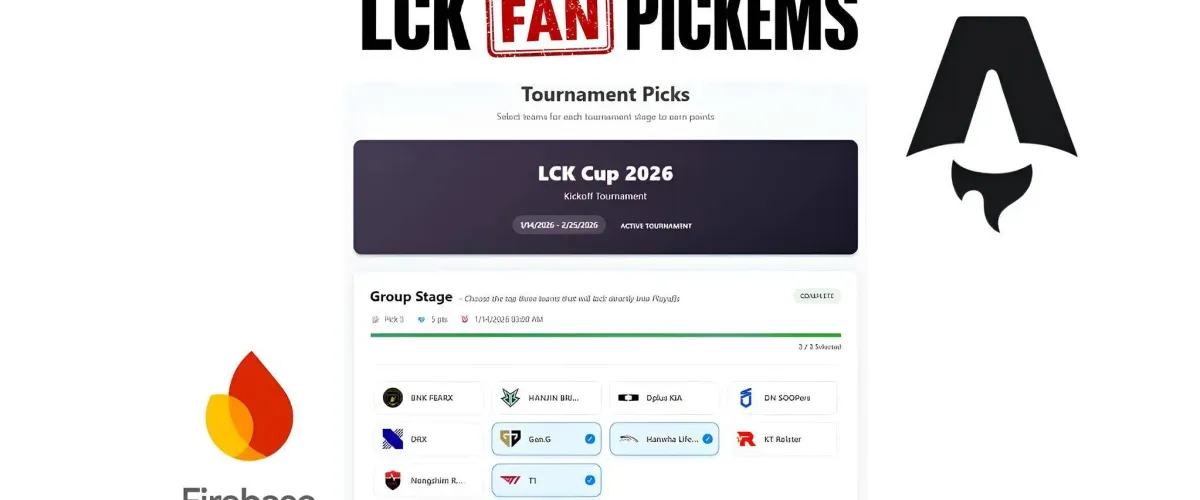
Building a Hybrid Esports Pick'em App with Astro and Firebase
- Astro
- Firebase
- Software Architecture
- Lautaro Lobo
- 02 Feb, 2026
Static sites are fast. They’re cheap to host and great for SEO. But what happens when you need to handle highly dynamic user data, as a fan pick’em web app for the LCK (League of Legends Champions Korea)?
You don’t have to abandon the benefits of Static Site Generation (SSG) for a full Single Page Application (SPA). By leveraging Astro’s Island Architecture and Firebase, I built Fan Pickems—an app that serves tournament data statically while handling user picks and authentication dynamically on the client.
Static Data vs. Dynamic Users
A Pick’em app has two distinct types of data:
- Tournament Data: Teams, schedules, and rules. This rarely changes.
- User Data: User authentication state and their specific picks. This is unique to every visitor and changes frequently.
A traditional SPA would fetch everything on the client, leading to loading spinners and slower First Contentful Paint (FCP). A traditional server-rendered app would require a running server, adding cost and complexity.
I wanted the best of both: the speed of static HTML for the tournament structure, and the interactivity of an SPA for the user’s picks. Here’s where Astro Islands come to the rescue!
Astro’s Islands architecture allows us to ship static HTML for the page shell and hydrate only the interactive components.
1. Fetching Tournament Data at Build Time
Since tournament schedules don’t change often, makes sense to fetch them at build time. In the PicksInterface.astro component, the frontmatter script runs only when the site builds:
---
import { getCurrentTournament, getTeamsFromIds } from "../../scripts/services/picks-service";

// This runs at build time!
const tournament = await getCurrentTournament();
let teams: Team[] = [];

if (tournament) {
  teams = await getTeamsFromIds(tournament.participatingTeams);
}
---
This generates static HTML with all the tournament details, and gets sent to the client-side script using data attributes:
<div
  class="picks-interface"
  id="picks-interface"
  data-tournament={JSON.stringify(tournament)}
  data-teams={JSON.stringify(teams)}
>
  <!-- Static HTML for the interface rendered here -->
</div>
<script src="./picks-interface.ts"></script>
2. Handling Dynamic User Data
While the tournament structure is static, the user’s interaction with it is dynamic. I have a separate TypeScript file, picks-interface.ts, to handle the client-side logic.
This script “hydrates” the static HTML. It connects to Firebase Authentication to check if a user is logged in and fetches their existing picks:
import { getAuth, onAuthStateChanged } from 'firebase/auth';
import { getUserPicksForTournament } from '../../scripts/services/picks-service';

// Initialize on the client
const auth = getAuth();

onAuthStateChanged(auth, async (user) => {
  if (user) {
    // User is logged in, fetch their specific picks
    getUserPicksForTournament(this.state.tournament.id, user.uid).then(userPicks => {
      if (userPicks) {
        // update UI with picks
        this.renderPicks();
      }
    });
  }
});
This separation allows the page to load instantly with the tournament grid visible. The user’s previous selections “pop” in a moment later once auth is confirmed, feeling quick and responsive.
3. Client-Side Validation
I’m also handling validation on the client to give immediate feedback. For example, ensuring a user doesn’t pick more teams than allowed or submit after the deadline:
export const validatePicks = (picks: UserPicks['picks'], tournament: Tournament) => {
  const errors: string[] = [];

  Object.entries(tournament.stages).forEach(([stage, config]) => {
    // Check deadline
    const now = new Date();
    const deadline = new Date(config.deadline.seconds * 1000);

    if (now > deadline) {
      errors.push(`Deadline for ${stage} has passed`);
    }
  });

  return { valid: errors.length === 0, errors };
};
I can enforce these same rules using Firestore Security Rules on the backend, ensuring that even if someone bypasses the client-side check, the database remains secure.
Conclusion
Thanks to the chosen hybrid architecture, I’m taking care of these three key points:
- Performance: The core content (the tournament grid) is static HTML.
- Cost: I host the site statically, avoiding the need for a dedicated Node.js server.
- Security: User data is secure through Firebase Auth and Firestore rules, separating public and private data.
This project serves as a demonstration that dynamic apps don’t always need a complex SSR setup. Astro’s static output and client-side islands allow you to create interactive applications that remain simple and performant.